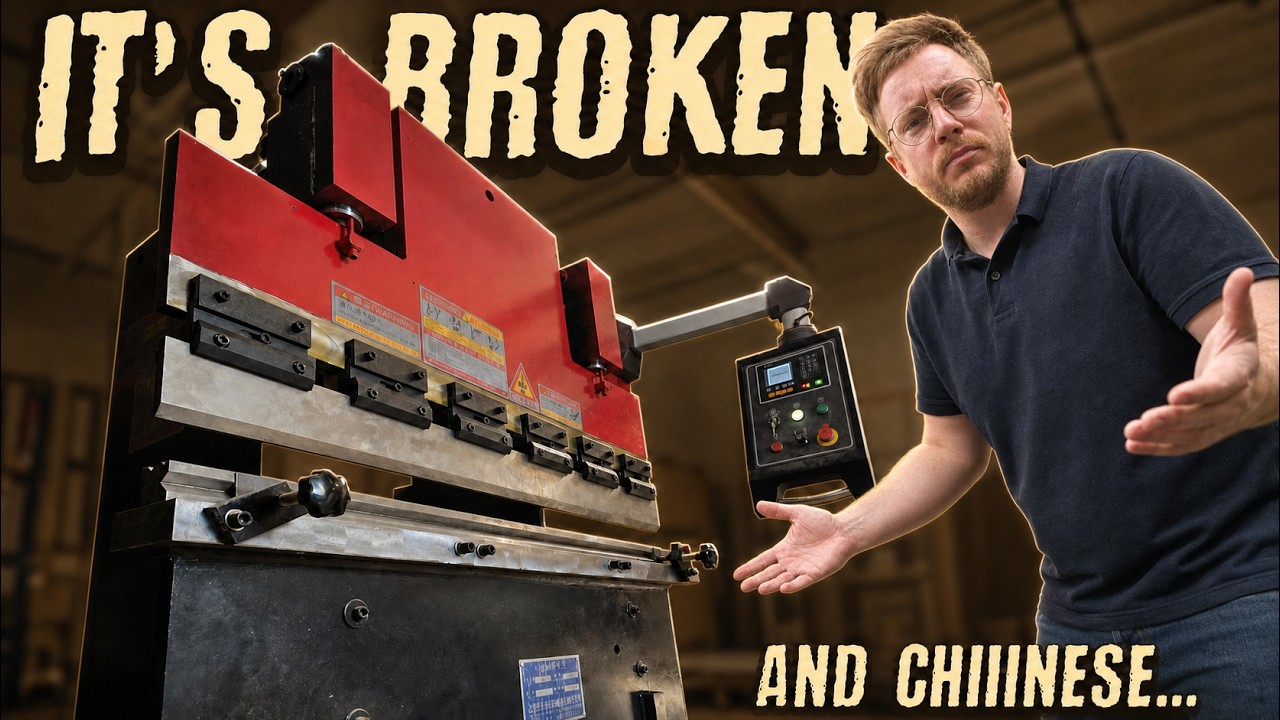
This 30-ton press brake repair started with a machine that sat in my shop for 18 months after it arrived leaking, misaligned and not remotely ready to work. This build log covers the hydraulic repair, encoder alignment, software calibration and the real question at the end: can a suspiciously cheap machine actually become a useful workshop tool?
Watch the full repair and calibration video here:
The gamble: a 30-ton press brake that arrived broken
I bought what felt like the TEMU version of a 30-ton hydraulic press brake for suspiciously little money, and it immediately turned into the kind of project nobody talks about in the listing photos. Instead of dropping it into the shop and getting to work, it sat for a year and a half because it arrived with enough issues that I couldn’t trust it to do accurate work.
This post is the written companion to that repair. It is not a glossy “cheap machine review.” It is the real path from broken import hardware to something that can finally bend steel on purpose instead of by accident.
What had to be fixed first in this 30-ton press brake repair
The first layer of problems was mechanical and hydraulic. Before accuracy even entered the conversation, the machine had to stop bleeding oil and start behaving like a press brake instead of a pile of scrap metal with a control screen attached.
- Hydraulic leaks: the system had leaks, tired seals and fittings that needed to be sorted before the machine could safely hold pressure.
- Pressure-side hardware issues: even basic confidence in the hydraulic system meant replacing bad hardware and verifying the machine would survive a real pressure test.
- Encoder alignment problems: the linear encoder setup was not mounted well enough to trust the ram position, which kills repeatability before you ever make the first accurate bend.
- Software calibration: the machine needed proper setup for ram depth and backgauge position, plus the math to land reliable 90-degree bends instead of trial-and-error guesswork.
Where the real work was: making it bend accurately
The most interesting part of this build was not fixing the obvious leaks. It was getting the machine to behave like a precision tool. A press brake only becomes useful when the control system, encoder feedback and bending math all agree on where the ram actually is and what the material will do.
That meant aligning the sensors properly, calibrating the depth, and working through the geometry needed to consistently hit a clean 90-degree bend. Cheap machinery often gets judged too early on raw hardware alone. In reality, the difference between “junk” and “usable” is often buried in setup, alignment and calibration work that should have been done before it left the factory.
The final test in the video is the only one that really matters: after the repairs and calibration, can the machine bend thick steel accurately enough to earn a place in the workshop? That is where this project shifts from restoration to proof.
The honest takeaway on cheap industrial imports
There is a version of this story where “cheap Chinese machinery” becomes either a miracle bargain or a total scam. The truth is less dramatic and more useful. Machines like this can make sense, but only if you price in the hidden work: troubleshooting, fixing what arrived wrong, validating the hydraulic system, checking alignment, and doing the calibration the supplier should have done.
If you are importing your own machine, the real risk is not just bad parts. It is buying a project when you thought you were buying a tool. If you have the patience and background to debug it, you may end up with a very capable machine for the money. If you need plug-and-play reliability on day one, the low sticker price gets expensive fast.
What I would inspect before buying one
- Hydraulic quality: seals, fittings, gauges and hose routing should not be an afterthought on a 200-bar system.
- Encoder mounting and feedback: if the position system is sloppy, bend accuracy will be sloppy too.
- Control calibration workflow: you want to know how the machine handles ram depth, backgauge setup and angle correction before it lands in your shop.
- Support reality: ask yourself whether the seller is actually going to help when something arrives broken, or whether you are the service department.
- Total project cost: include repair time, replacement parts, measurement tools and the opportunity cost of a machine that may sit for months before it makes its first good part.
FAQ: repairing a cheap 30-ton press brake
Related posts
- Kitamura Mycenter Zero — CNC Mill Retrofit — a deeper look at what it takes to bring serious machine hardware back into useful service.
- Makera Z1 Full Teardown: What’s Really Inside This CNC Machine — what you learn when you stop trusting the marketing and start opening the machine.
- The Cooling Point Trick That Fixed My Blowouts on 8mm Carbon Steel — another workshop problem where the fix came from understanding the process, not just changing settings at random.
The full video runs 18 minutes, 28 seconds and covers the repair from hydraulic leak diagnosis through the final 90-degree bend test.